Dinner Hall Decibels: What Youth Radio Teams Learn When the Show Goes on Tour
Photo: Rudolf H. Boettcher, CC BY-SA 4.0, via Wikimedia Commons
It's 8:15 on a wet Tuesday morning in a school hall somewhere off a ring road, and a 16-year-old presenter called Ruby is trying to work out where to put a condenser mic so it doesn't pick up the clatter of a dinner trolley being dragged across tarmac outside.
This is the unglamorous side of youth radio in 2026. The glossy bit — the shiny studio, the headphones, the jingle — stays at base. What travels is a van, four bags of cables, a portable desk, two presenters, one producer and a healthy amount of blind optimism.
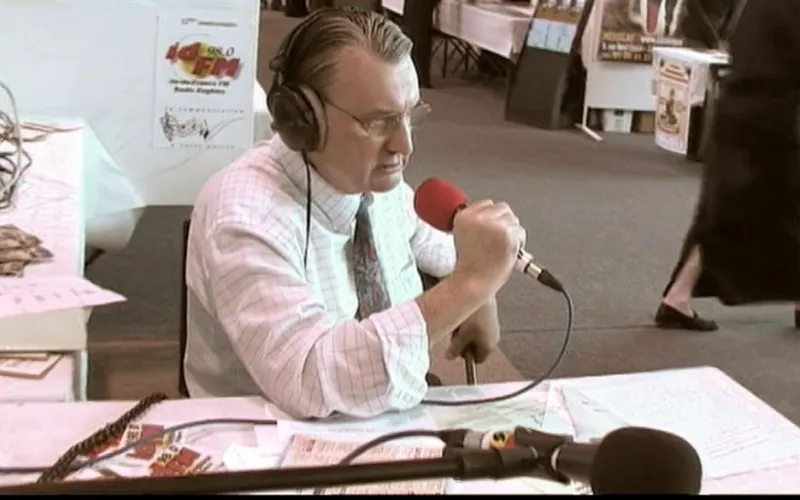
Over the past few months, more grassroots stations have been taking their shows out of the studio and into rooms where actual humans sit and watch. School assemblies, youth clubs, community centres, the odd library. It's part outside broadcast, part gig, part recruitment drive. And it is a completely different craft.
The 8am van load
The first lesson hits before the show even starts: a school hall is not a studio. It echoes. It hums. There's a heating system that sounds like a distant jet, and a caretaker who quite reasonably wants to know why there are twelve cables taped across his corridor.
Most teams we spoke to have a stripped-back roadshow kit — a compact mixer, a couple of dynamic mics (more forgiving in a live room than delicate condensers), a laptop running the playout system, a 4G router as backup, and a stack of gaffer tape. Everything labelled. Everything in one box. Anything that needs two people to carry stays at home.
"The first time we went out, we took everything," says Dan, a volunteer producer at a youth station in the North West. "We used about a third of it and lost two adaptors. Now we take what fits in the boot of one car."
The silence problem
Here's the thing nobody warns you about: live audiences don't clap when you expect them to.
In a studio, the presenter talks into the void and it feels normal. In a hall, forty Year 9s stare at you and the silence has weight. Jokes land late. A pause stretches one second too far and suddenly feels like a fortnight.
Several presenters said the same thing — the trick is to stop performing at the room and start including it. Ask the front row a question. Get a show of hands. Name a teacher in a nice way and let the room react. Once the audience realises they're part of the programme rather than a test audience, the wall comes down.
Shy interviewees and the six-second rule
The most common roadshow segment is the quick-fire interview: grab a pupil, a youth worker, a dinner lady, a head of year, and get thirty seconds of real talk. In theory, lovely. In practice, the first interviewee is often frozen solid.
One producer explained her six-second rule: count to six in your head before filling a silence. Most people, given those few seconds, will say something genuine. Fill the gap too quickly and you get a polite non-answer, and then the whole thing dies.
Other teams swear by handing the interviewee a question sheet beforehand, or pairing nervous first-timers with a friend so it feels like a chat rather than an exam. One station lets shy contributors record a voice note on their own phone and sends it in later. Not everything has to be live.
The moment the room flips
Ask anyone who's done a school hall tour and they'll tell you about a specific moment. Usually it's about twenty minutes in. A quiet year group — the ones who arrived arms folded — suddenly starts volunteering answers. Someone asks if they can have a go on the mic. A kid who's barely spoken all term turns out to have an opinion about the local bus timetable that could fill a fifteen-minute phone-in.
That's the bit worth the van and the cables. Youth radio's whole pitch is that young voices belong on air, and a school hall makes that argument physically obvious. You can see the moment someone realises the mic is not a barrier but an invitation.
The boring bits that actually matter
Safeguarding is the least exciting subject in radio and the most important one on the road. Any station planning to broadcast from a school or youth club needs the paperwork sorted well in advance: consent forms for any under-18 contributor, a named safeguarding lead on site, a clear rule about what gets broadcast and what's recorded for internal use only, and a producer whose sole job is to watch the room rather than the desk.
Practicalities too: check the room's power supply, find out whether the school's Wi-Fi blocks your streaming service, and always have a fallback plan — a pre-recorded show on a USB stick has saved more roadshows than any piece of hardware.
Five things to steal for your own roadshow
- Travel light. If it needs two people and a trolley, leave it behind.
- Rehearse the first three minutes. A tight, warm opening settles the room.
- Bring a runner. Someone whose only job is looking after guests and cables.
- Record everything, broadcast some. Not every brilliant moment belongs on air.
- Thank the caretaker by name. You will need them again.
The tour isn't always slick. Mics fail, kids wander off, one memorable show was briefly derailed by a fire alarm. But the stations doing it keep going back — because a school hall, it turns out, is one of the best studios a youth radio team can borrow for a morning.